Skip to content
📜 History
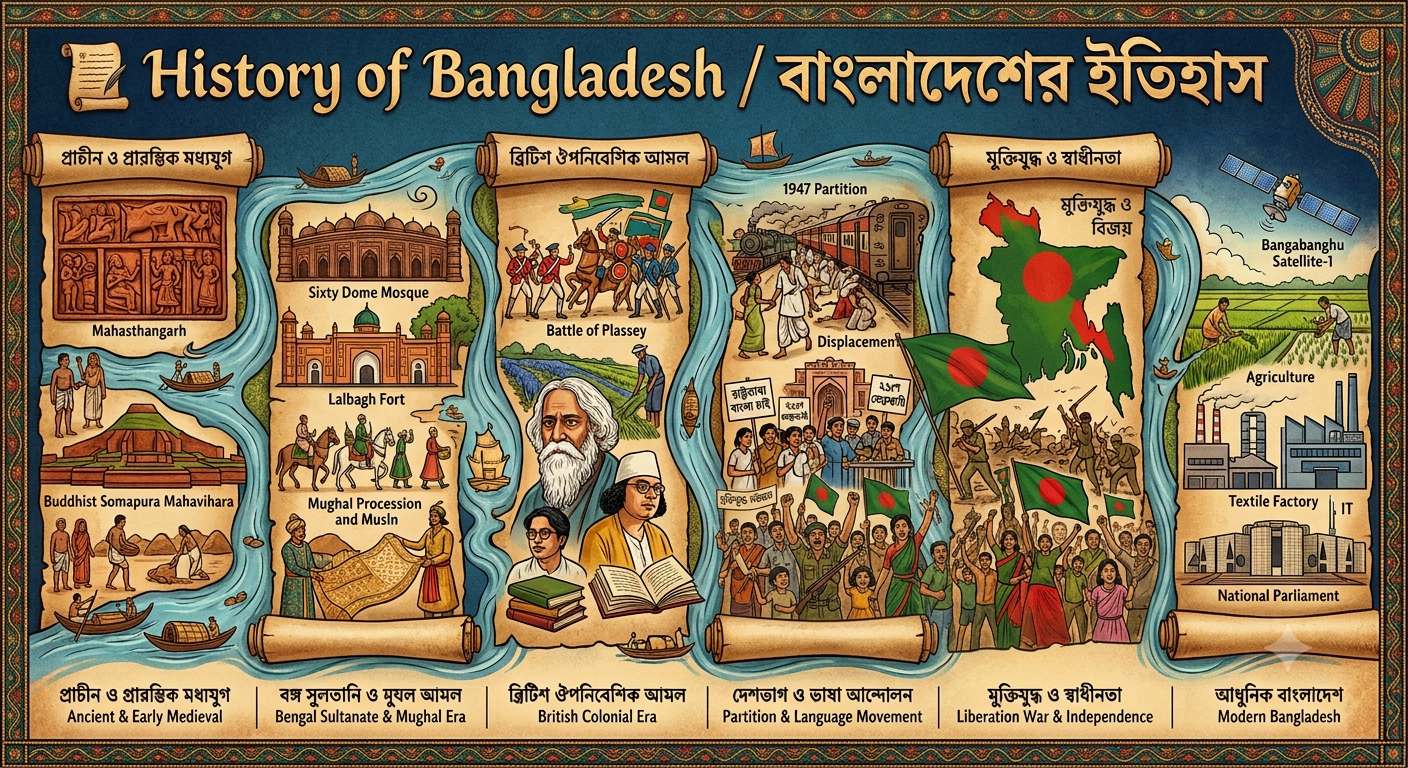
- Ancient Period (Before 1200 CE) 🏺 The Bengal region was home to early civilizations like Pundra, Gauda, and Vanga. Buddhism flourished under the Mauryan and Gupta Empires, while Hindu kingdoms also thrived. The area became a crossroads of trade, culture, and religion.
- Medieval Era (1200–1757) 🕌 The Bengal Sultanate established Dhaka as a major city, famous for its mosques and textiles. Later, under the Mughal Empire, Bengal became one of the richest provinces, exporting muslin cloth worldwide. Architecture like Lalbagh Fort and Sixty Dome Mosque reflect this era’s grandeur.
- Colonial Period (1757–1947) 🇬🇧 After the Battle of Plassey (1757), Bengal fell under British East India Company control. The colonial era brought railways, modern education, and administrative reforms, but also famines, economic exploitation, and cultural suppression.
- Partition of Bengal (1947) ✂️ With the end of British rule, Bengal was divided. East Bengal became East Pakistan, while West Bengal joined India. This created political and cultural tensions, as East Pakistan’s majority population felt marginalized.
- Language Movement (1952) 📖 When Urdu was declared the sole state language of Pakistan, Bengalis protested to preserve Bangla. On 21 February 1952, several students were killed in Dhaka. Their sacrifice is honored as International Mother Language Day, recognized globally.
- Liberation War (1971) ⚔️ Following years of political discrimination, the people of East Pakistan demanded autonomy. After a brutal crackdown on March 25, 1971, a nine-month war ensued. With support from India, Bangladesh achieved independence on December 16, 1971, marking the birth of a sovereign nation.