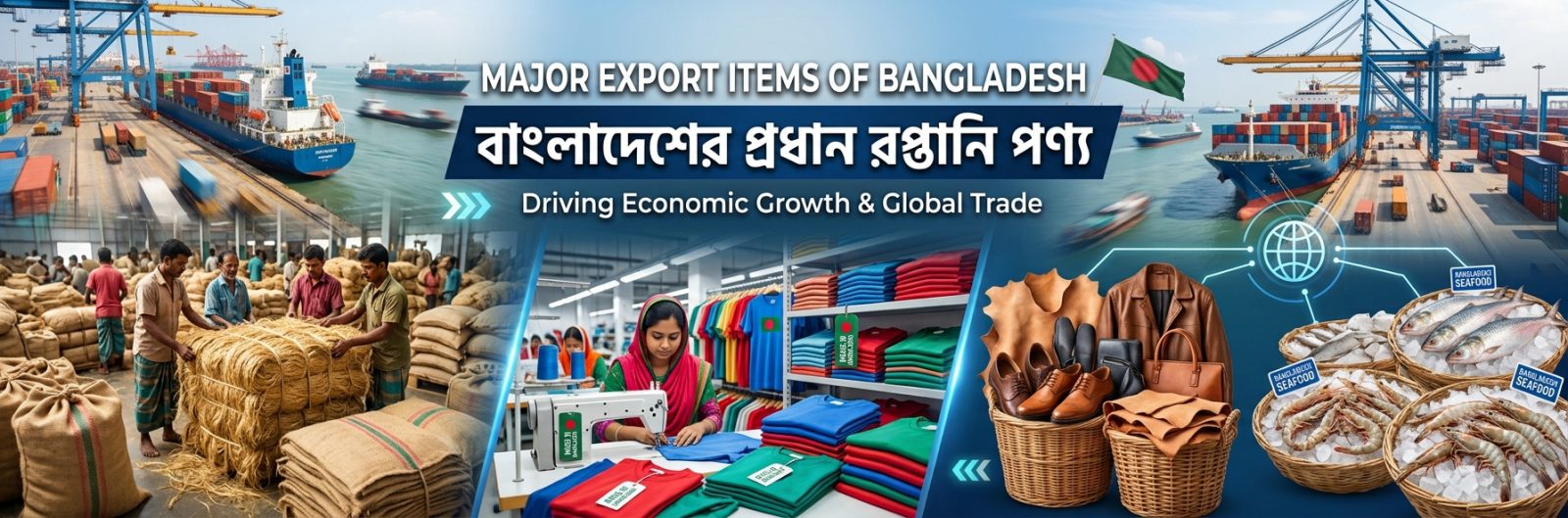
📦 Major Export Items
Bangladesh's export economy is dominated by the Ready-Made Garments (RMG) sector, which alone accounts for roughly four-fifths of total export earnings. Beyond garments, the country exports a diverse mix of agro-based, leather, fisheries, and increasingly pharmaceutical and IT/services products. The table below summarizes the country's major export items.
1. Readymade Garments (RMG)
- Share of Total Exports: ~80% – 85%
- Key Sub-categories:
- Knitwear: T-shirts, sweaters, polo shirts, innerwear.
- Woven Garments: Trousers, denim jeans, formal shirts, jackets.
- Major Destinations: USA, Germany, UK, Spain, France, Italy.
2. Home Textiles & Miscellaneous Textiles
- Items: Bed linen, towels, cushion covers, curtains, rugs, and kitchen linen.
- Highlights: One of Bangladesh's key non-clothing textile sectors supplying global home retail chains.
3. Leather & Footwear
- Items: Leather shoes, sports footwear, leather bags, belts, wallets, and finished leather goods.
- Major Destinations: European Union (Germany, Spain, Netherlands), Japan, USA.
4. Jute & Jute Goods (Golden Fiber)
- Items: Raw jute, jute yarn/twine, hessian cloth, sacking bags, jute carpets, and diversified eco-friendly handicrafts.
- Major Destinations: India, Pakistan, China, Middle East, Turkey.
5. Frozen Seafood & Fish
- Items: Black Tiger Shrimp (Bagda), Freshwater Prawns (Galda), and frozen sea fish.
- Major Destinations: European Union, USA, Japan.
6. Agricultural & Processed Food Products
- Items: Aromatic rice, spices, dry snacks, juices, fresh vegetables, and fruits.
- Major Destinations: Middle East, UK, Malaysia, South Asia.
7. Pharmaceuticals & Chemical Goods
- Items: Finished formulations (tablets, capsules, syrups), active pharmaceutical ingredients (APIs), and plastic goods.
- Highlights: Bangladesh exports generic medicines to over 140 countries.
8. Light Engineering & Bicycles
- Items: Bicycles, electrical appliances, auto parts, and metal hardware.
Major Destinations: UK, EU countries.
Summary Table
| Rank | Export Item | Category | Approx. Share of Total Exports | Major Export Markets |
|---|---|---|---|---|
| 1 | Woven Garments | Ready-Made Garments (RMG) | ~40% | European Union, USA, UK |
| 2 | Knitwear Garments | Ready-Made Garments (RMG) | ~40% | European Union, USA, UK |
| 3 | Home Textiles | Textiles | ~2–3% | USA, European Union |
| 4 | Leather & Leather Goods (incl. footwear) | Leather | ~2–3% | European Union, USA, China |
| 5 | Frozen & Live Fish (shrimp, hilsa) | Agro / Fisheries | ~1–2% | European Union, USA, UK, Japan |
| 6 | Jute & Jute Goods | Agro-based / Fibre | ~1–2% | India, Turkey, European Union |
| 7 | Agricultural Products (vegetables, tea, etc.) | Agro-based | <1% | Middle East, UK |
| 8 | Pharmaceuticals | Chemical / Pharma | <1% (fast-growing) | Africa, Asia, CIS countries |
| 9 | Plastic Products | Manufacturing | <1% | India, European Union |
| 10 | Ceramic Products | Manufacturing | <1% | USA, European Union, Australia |
| 11 | Footwear (non-leather) | Manufacturing | <1% | European Union, USA |
| 12 | ICT & IT-Enabled Services | Services | Growing | USA, UK, various |
Why Ready-Made Garments Dominate
Low-cost, large-scale labor combined with decades of buyer relationships, duty-free/quota-free market access under the EU's Everything But Arms (EBA) scheme, and a mature backward-linkage textile industry have made Bangladesh the world's second-largest garment exporter after China. Woven and knitwear garments together typically make up over 80% of the country's total export earnings.
Key Export Destinations
- European Union — the single largest market, benefiting from duty-free access under the EBA scheme.
- United States — the largest single-country destination for Bangladeshi garments.
- United Kingdom — a major long-standing RMG buyer, continuing preferential access post-Brexit.
- Japan, Canada, Australia — growing non-traditional markets for garments and fisheries products.
- India, Middle East, and other Asian markets — key destinations for jute, agricultural products, and pharmaceuticals.
Note: the figures above are approximate and illustrative, meant to give a general sense of Bangladesh's export composition. For exact, up-to-date statistics, consult the Export Promotion Bureau (EPB) or Bangladesh Bank.